


AI Assisted Pipeline to Beat Ad Creative Fatigue for Marketers

Ad creative fatigue is the decline in engagement that happens when your audience sees the same creative too many times. The fix isn’t a bigger budget or a new algorithm setting. Pull three numbers today: per-creative frequency, your 7-day click-through rate slope, and each creative’s share of spend. Any creative that trips two of those signals at once needs a replacement in the pipeline now, not next week.
TL;DR:
- Creative fatigue can occur within one to three weeks on fast-moving feeds like TikTok, making rapid replacement critical.
- Monitoring a combination of frequency, click-through rate decline, and share of spend helps detect fatigue before ROAS drops significantly.
- Running controlled swap tests between creatives distinguishes whether fatigue or audience saturation causes declining performance.
- Building a modular asset library and using AI-assisted generation reduces production time, enabling faster creative replacements.
- To prevent burnout, teams should implement a clear operational system with ownership, automation, and a prebuilt bench of variant creatives.
Table of Contents
- What Is Ad Creative Fatigue, and Why Does It Move So Fast Now?
- How Do You Detect Creative Fatigue Before It Tanks Your CPA?
- Is It Creative Fatigue or Audience Saturation? Run This Check First
- Building an Operational Framework That Catches Fatigue Early
- Modular Production and AI-Assisted Generation Keep the Pipeline Fast
- Running Always-On Creative Without Burning Out Your Team
- A Faster Way to Keep Fresh Creative in the Queue
- Where to Go Deeper on Creative Fatigue
- Sources
What Is Ad Creative Fatigue, and Why Does It Move So Fast Now?
Creative fatigue is not the same thing as ad fatigue or audience saturation, even though marketers use the terms interchangeably. Creative fatigue is specific to one asset: the same image, video, or copy loses its pull because the audience has seen it enough times to stop noticing it. Audience saturation is broader. It means you’ve exhausted the pool of people worth reaching, regardless of which creative you show them. Amazon Ads’ guidance on ad fatigue draws this line clearly, and it matters because the two problems call for opposite fixes.
The mechanism behind creative fatigue traces back to habituation, a well-documented behavioral pattern where repeated exposure to the same stimulus produces a shrinking response. Research on habituation and attention shows this decline isn’t a marketing quirk. It’s how attention works biologically. Ad platforms compound the effect. Meta’s own guidance on managing repeated creative exposures confirms that engagement drops measurably once the same audience segment sees an ad enough times, and the algorithm responds by quietly downranking delivery.
What’s changed is the clock speed. A creative that used to run profitably for six to eight weeks might burn out in one now, especially on fast-moving feeds. That shift raises the real constraint every performance team faces:
- Novelty gets rewarded early with cheaper delivery and higher relevance scores.
- Stale creative gets punished with rising costs, not just falling clicks.
- Replacement speed, not creative quality alone, decides whether your account keeps its efficiency.
How Do You Detect Creative Fatigue Before It Tanks Your CPA?
The signals are all sitting in your ads dashboard already. You just need to watch the right combination instead of reacting to one metric in isolation.
Frequency is the most talked about but least reliable signal on its own. A creative running at a frequency of 3 to 4 per week on Meta prospecting campaigns is entering risk territory, while fast-moving feeds like TikTok often show decay within two to three weeks, sometimes days at scale, according to Segwise’s breakdown of ad creative fatigue signs. But frequency alone doesn’t prove fatigue. It just means exposure is climbing.
Click-through rate slope over a rolling 7 to 14 day window is a stronger indicator, because it shows direction, not a single snapshot. A creative with a flat CTR for three weeks and then a steady downward slope is telling you something frequency can’t.
Creative share of spend is the signal most teams skip, and it’s often the earliest one to move. Admiral Media’s analysis of the creative fatigue curve found that monitoring spend share and per-creative CTR slope catches decay before account-level ROAS shows any damage at all. By the time your blended return on ad spend dips, the fatigued creative has usually been bleeding efficiency for days.
CPM and CPA trends round out the picture. Rising cost per impression alongside rising cost per acquisition on one specific creative, while others in the same ad set hold steady, is a fatigue fingerprint.
Pro Tip: Build a simple traffic light view: green for creatives with stable CTR and frequency under threshold, yellow for one signal tripped, red for two or more. It turns a spreadsheet of numbers into a five-second scan every Monday.
Here’s the trigger rule worth automating rather than eyeballing:
- Frequency exceeds your channel’s typical threshold (roughly 3 to 4 weekly on Meta prospecting, lower on fast feeds).
- CTR has declined 10 to 15% or more over a rolling 7-day window compared to its peak.
- CPA or CPI has risen 15% or more over the same window.
Flag any creative that hits two of these three, a rule Admiral Media’s fatigue curve model backs as reliable across mobile app and social campaigns. One signal alone is noise. Two together is a pattern worth acting on.
Building the dashboard itself doesn’t require custom software. A pivot table pulling per-creative frequency, CTR, and spend by day, refreshed with a 7-day rolling average, catches most of what you need. Set an alert (even a simple conditional format or a Slack webhook tied to your ad platform’s API) when two signals cross their thresholds simultaneously.
Is It Creative Fatigue or Audience Saturation? Run This Check First
Getting the diagnosis wrong wastes both budget and time, because the fixes for creative fatigue and audience saturation pull in opposite directions. The fastest way to tell them apart is a controlled swap test.
Replace the suspected creative inside the same ad set, targeting, and bid strategy, then watch CTR and CPA over the next 5 to 7 days.
- If performance recovers with the new creative, you’re dealing with fatigue, not saturation.
- If performance stays flat or keeps declining even with fresh creative, the audience itself is likely exhausted, or the offer has stopped resonating.
- If results are mixed, run the swap once more on a different creative before drawing conclusions. One data point can mislead.
Once you know which problem you’re solving, follow an action ladder instead of guessing. Refresh the creative first, since it’s the cheapest and fastest lever. If that doesn’t restore performance, expand or shift targeting, or revisit the offer itself. If neither works, pause the ad set and reallocate spend before it drags down account-level efficiency. Skipping straight to a targeting overhaul when the real issue is a tired asset wastes both time and learning phase.
Building an Operational Framework That Catches Fatigue Early
Detection only matters if it feeds into a workflow that produces a replacement fast. Most teams that struggle with creative fatigue don’t lack data. They lack a system that turns a red flag into a live replacement within days instead of weeks.
Start with phase tagging. Admiral Media’s creative fatigue curve framework categorizes every active creative into one of four stages: Ramp, Peak, Decay, or Saturation. Tagging each creative weekly forces a Monday review ritual where someone actually looks at the dashboard instead of assuming last week’s winner is still winning.
- Monitor: Every Monday, pull frequency, CTR slope, and spend share for all active creatives and tag each by phase.
- Trigger: Any creative hitting two of the three fatigue signals moves into the refresh queue immediately, not at the next planning cycle.
- Brief: Creative ops receives a short brief within 24 hours of the trigger, specifying which element to vary (hook, visual, offer framing).
- Build: Production begins the same day, targeting a live replacement within 3 to 5 business days for most channels.
- QA and launch: A quick creative and compliance check precedes go-live, staged alongside the existing creative rather than replacing it outright.
That staging detail matters more than it sounds. Pulling a fatigued creative cold and launching a brand-new one from zero often resets the ad set’s learning phase, which costs you a few days of inflated CPA while the algorithm relearns delivery. Running the replacement alongside the fatiguing creative for a short overlap, then shifting budget once the new asset proves itself, avoids that reset penalty.
Maintain a bench of replacements for your top-spending creatives before you need them, not after. A reasonable target is two to three ready variants per high-spend creative, built from a modular library rather than from scratch each time. This is where a testing framework for ad hooks earns its keep. Testing hooks continuously, even on creatives that haven’t fatigued yet, keeps the bench stocked.
Pro Tip: Assign one person, not a committee, to own the Monday fatigue review. Decisions made by committee take days; decisions made by one accountable owner with clear thresholds take minutes.
Ownership should split cleanly: media buyers own monitoring and alerts, creative ops owns the brief-to-build cycle, and a single approver signs off on brand and compliance before anything goes live. Automating the alert trigger through your ad platform’s API or a simple dashboard rule removes the guesswork about when to escalate.
Modular Production and AI-Assisted Generation Keep the Pipeline Fast
The single biggest bottleneck in any fatigue-fighting workflow isn’t detection. It’s production speed. Forbes Technology Council’s take on beating ad fatigue argues that shifting from one-off creative swaps to a system of reusable variables, modular components recombined into new outputs, is the most scalable defense available to teams that don’t have unlimited production budgets.
A modular library breaks every winning creative into its component parts:
- Hooks: the first 2 to 3 seconds of a video or the headline of a static ad.
- Backgrounds and settings: the visual context, which can rotate independently of the message.
- Overlays and copy variants: text, captions, and calls to action layered on top.
Recombining these pieces produces genuinely new-feeling variants without rebuilding a shoot from scratch every time. This is where AI-assisted generation earns a real operational role, not as a novelty but as a way to compress a multi-day production cycle into hours. A platform like InfluencerForge can generate fresh UGC-style variants from an existing library while keeping a model’s face and identity consistent across outputs, which matters when brand recognition depends on a recurring presenter or spokesperson.
Platform differences shape how you plan the pipeline. Meta prospecting campaigns can often run a strong creative for several weeks before frequency creeps past 3 to 4, while TikTok and other fast, algorithm-driven feeds tend to fatigue in two to three weeks or faster once a campaign scales, per Segwise’s channel comparison. Plan your bench depth accordingly: TikTok needs a deeper, faster-moving variant queue than a slower-burning Meta campaign.
Running Always-On Creative Without Burning Out Your Team
Every framework in this article assumes a team with the capacity to execute it, and that assumption deserves scrutiny. A recent Marketing Week survey found roughly 55% of marketers reporting emotional exhaustion, a number that should temper any advice telling you to simply “produce more, faster.” Always-on testing sounds efficient on a slide deck. It’s a different experience for the person briefing five variants a week with no reduction in anything else on their plate.
The heuristic that actually helps under constraint: replace the creative with the highest spend share and the earliest CTR decline first. That’s where a stale asset costs you the most money the fastest, and it’s usually a smaller list than the full fatigue queue suggests.
Good governance matters more than good tools here. Set clear reuse rules so creative ops isn’t rebuilding briefs from zero every cycle, keep brand guardrails simple enough that approval doesn’t become a bottleneck, and protect space for people to flag a rushed variant without feeling like they’re slowing the machine down. Velocity that breaks your team isn’t velocity. It’s borrowed time.
— Tim
A Faster Way to Keep Fresh Creative in the Queue
This approach shortens the exact bottleneck this article keeps circling back to: the days between “this creative is fatiguing” and “the replacement is live.” Instead of scheduling a new shoot every time your bench runs low, teams can train one identity-locked model and generate new UGC-style variants, hooks, backgrounds, and framing, from that same library in minutes rather than days.
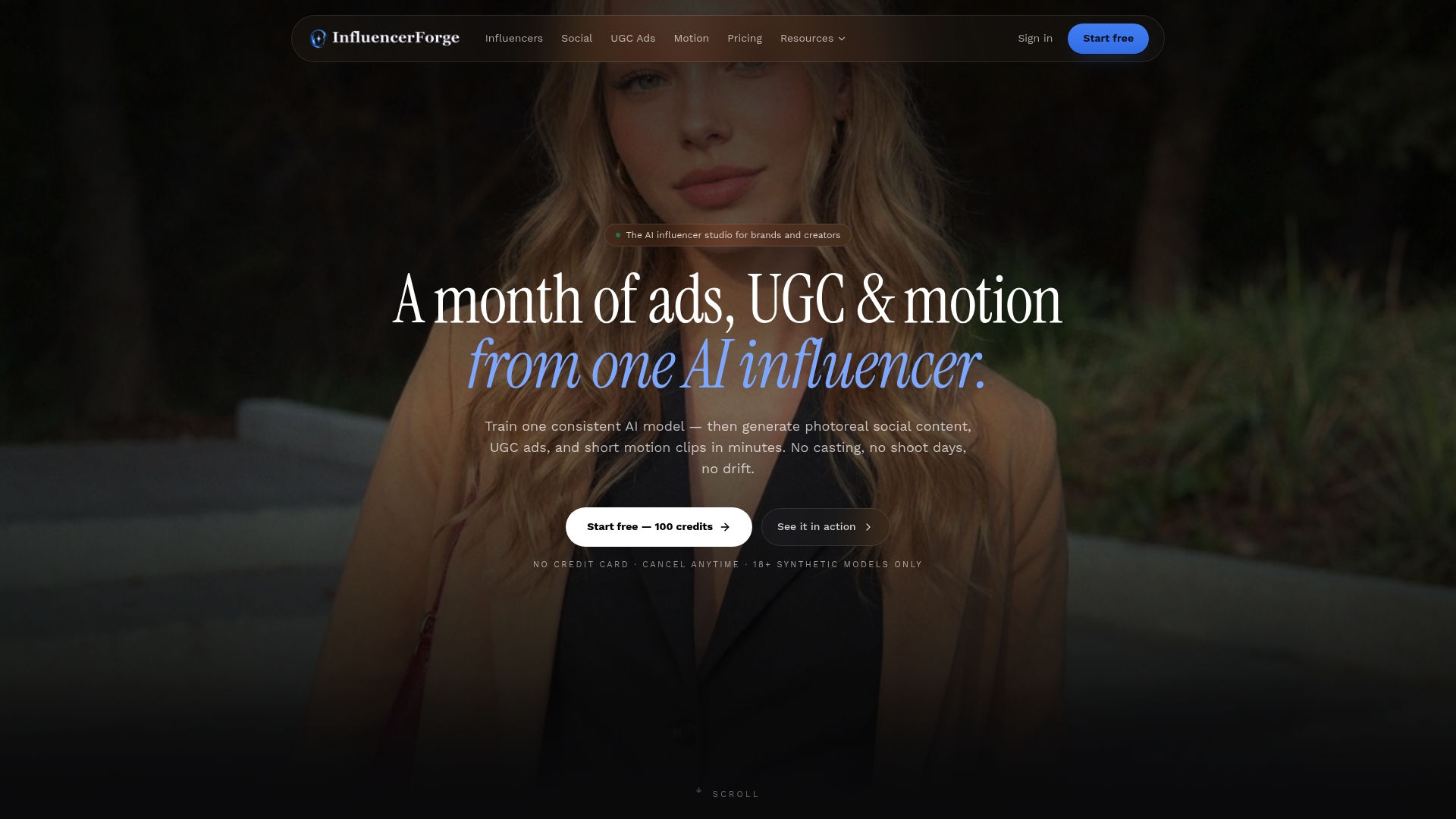
If your team is watching a top-performing static ad start to slide, one practical move is turning that winning still into a motion clip variant without waiting for a fresh video shoot to get scheduled. That’s the kind of replacement speed a two-signal fatigue trigger demands, and it’s exactly what the AI UGC ad generator is built to produce. Check the use case page, see how identity lock keeps your spokesperson consistent across every new variant, and start building your replacement bench before your next Monday fatigue review.
Where to Go Deeper on Creative Fatigue
A handful of sources back the frameworks above and are worth bookmarking for your own team’s playbook.
- Meta’s Ads Manager guidance on repeated exposures, for platform-specific diagnostic cues.
- Admiral Media’s creative fatigue curve, for the phase model and two-signal trigger methodology.
- Forbes Technology Council, for the case on modular, AI-assisted production.
- Marketing Week’s burnout reporting, for the team-capacity context behind always-on testing.
- Amazon Ads’ ad fatigue guide, for baseline definitions and mitigation tactics.
Sources
- Creative Fatigue Recommendations in Meta Ads Manager
- The Creative Fatigue Curve: When and Why Ads Stop Working
- How Do You Beat Ad Fatigue When Your Best Creative Dies In A Week?
- What is Ad Fatigue? How to Diagnose, Prevent, and Cure It | Amazon Ads
- ‘Absolute crisis’: Are marketers at breaking point?